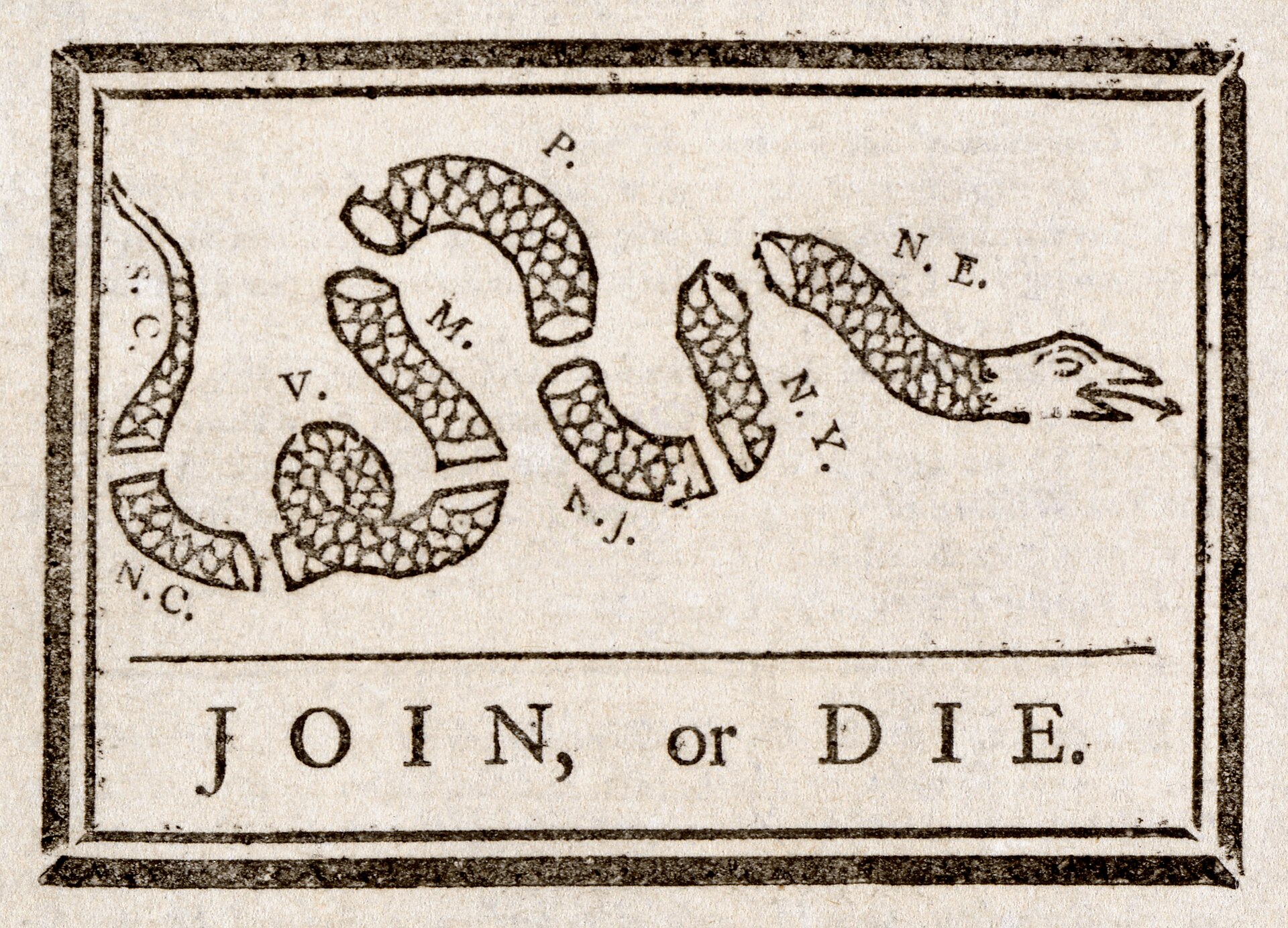
Benjamin Franklin published “Join, or Die” in the Pennsylvania Gazette on May 9, 1754, alongside an editorial calling for the colonies to coordinate against French incursions on the Pennsylvania frontier. The snake is severed into eight pieces — New England, N.Y., N.J., P., M., V., N.C., S.C. — under the warning that disunity is fatal.
Franklin drew it as a colonial-defense argument, not a revolutionary one. The Albany Congress later that summer adopted a unity plan he had drafted. The cartoon then went dormant for a generation.
In 1765, colonial newspapers revived it to protest the Stamp Act. By 1776, it had become iconography of the Revolution. The same image, reused for a different fight.
The enduring point isn’t unity-as-pageantry. It’s that fragmented governance — branches or institutions unable to coordinate against a common threat — is a survival problem. Article I, the legislative branch, is what coordinates the United States as a single political entity. When Congress surrenders its powers piece by piece to the executive — war powers, appropriations, oversight, the power to choose its own membership — the snake gets severed in a different direction.